Matriarchy as a Golden-Age Myth
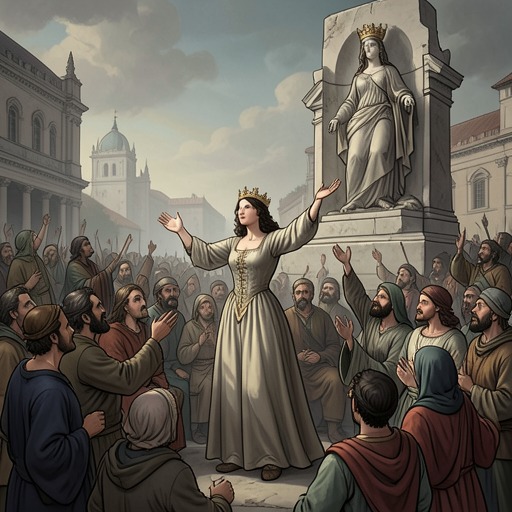
The Second SexIn The Second Sex, matriarchy as a golden-age myth is the belief that an ancient age of women’s rule preceded patriarchy. Simone de Beauvoir disputes that reconstruction: even where women appeared powerful as mothers, goddesses, or rulers, they did not thereby become autonomous political subjects or reciprocal equals of men. The myth matters because it confuses symbolic prestige with social authority, masking how patriarchal power persisted through changing systems of descent, religion, and family life.
The hypothesis and its limits
Beauvoir considers the hypothesis, proposed by Johann Jakob Bachofen and adopted by Friedrich Engels, that primitive society had known a genuine reign of women and that the shift from matriarchy to patriarchy constituted women’s great historical defeat. Traditions and literary memories can seem to support this account. Some ancient societies preserved stories of formidable mothers, and figures such as Niobe and Medea suggest a time when mothers might have regarded their children as their own. In Homeric poetry, Andromache and Hecuba occupy a more prominent place than women in the classical Greek household later did. Such traces, however, do not establish that women collectively governed society or stood as men’s equals.
The decisive distinction is between being elevated as a sacred or natural power and possessing authority within human society. Woman could be imagined as Earth, Mother, or Goddess, but that exaltation placed her beyond ordinary social relations rather than admitting her as a peer. Beauvoir therefore calls the golden age a myth: divine importance and maternal prestige do not, by themselves, demonstrate women’s sovereignty. The image of a woman enthroned as the source of fertility can coexist with a social order in which men make political decisions.
Descent, marriage, and authority
The argument turns on who controls relations among groups. Beauvoir maintains that men, not women, have historically treated other men as reciprocal counterparts and subjects. Women instead have been positioned as goods exchanged between male groups and as the means through which those groups establish relations. In this analysis, marriage’s reciprocal bond is not primarily an autonomous agreement between a woman and a man; it serves as a relation connecting men through a woman.
Matri-lineal descent does not necessarily alter that underlying arrangement. A woman may belong to a line traced through women yet remain subject to the authority of her father or brother, or pass under her husband’s authority after marriage. She mediates the law of descent without possessing it. Beauvoir stresses that the practical location of the conjugal household matters alongside formal kinship: women usually move to live under their husbands’ roofs, a pattern she reads as evidence of male domination even when descent is not patrilineal.
A queen or woman chief likewise cannot be taken as proof that women as a group are sovereign. Beauvoir’s example is Catherine the Great: her reign did not transform the condition of Russian peasant women. Individual female rule and collective female authority are different matters. The presence of a powerful woman at the top of a hierarchy does not undo the subordination of women in the society beneath her.
How maternal prestige is reclaimed by patriarchy
Beauvoir describes a gradual shift in the religious image of power. In some fertility traditions, a Great Mother is accompanied by a god or lover who remains subordinate to her. But the balance changes as male gods assume supremacy. In Egypt, goddesses remain important, yet Ra is supreme; in Babylon, Ishtar is the wife of Bel-Marduk, who creates and guarantees harmony. When Zeus rules in Greece, Gaea, Rhea, and Cybele lose their former position, while Demeter remains secondary. The changing pantheon provides a history of representation, not evidence that women once controlled political life.
Even when men revered the Mother Goddess, Beauvoir argues, the terms of that reverence were set by men. The goddess’s prestige arose from male consciousness and could therefore be withdrawn or reorganized by it. Men could worship a feminine divine figure while retaining authority over society; the sacred woman remained an image men had fashioned, not a sovereign subject who established her own law. The recurrence of powerful female divinities alongside the rise of male gods makes the point: religious prominence and social power need not coincide.
From fertility to social subordination
Beauvoir connects this distinction to the development of work, family, and social power. Men’s attachment to sons, and their wish to affirm themselves as fathers, helped societies tend toward patriarchal forms. As men sought to impose their will, women’s productive and reproductive roles were assigned meanings that limited their independent position. Women were credited with sustaining life and nourishing the group, while men claimed activities that expanded the group’s reach beyond its immediate existence.
The consequences were not simply a matter of biological capacity. Beauvoir argues that new tools and productive arrangements could have changed women’s opportunities, but women were excluded from the shared work and social participation through which men recognized one another as equals. The resulting hierarchy then represented that exclusion as an inherent female limitation. Fertility could win a woman reverence without giving her control over the institutions that shaped her life. In this way, the supposed golden age does not explain women’s emancipation or establish a lost era of equality; it can instead disguise how symbolic honor and material subordination operated together.
Historical significance
The golden-age myth belongs to Beauvoir’s wider account of women as the Other: women have not formed a unified group able to define itself independently of men, and their relations to fathers, husbands, homes, and social interests have often divided them from one another. Unlike a subordinated class organized around shared labor, women are dispersed among men and tied to them through intimate and economic relations. The image of a former matriarchy can obscure this structural difference by suggesting that women once held power as a collective and merely lost it in a single historical reversal.
Beauvoir’s account also challenges explanations that treat women’s subordination as natural and unchanging. She argues that patriarchy was neither a simple accident nor merely the consequence of a violent revolution; it developed through men’s continuing assertion of authority and through social arrangements that kept women from becoming equal participants. A mythic past in which the Mother ruled may appear to reverse male supremacy, but it does not establish reciprocal relations between the sexes. Its critical use lies in showing how easily an image of female power can be mistaken for women’s actual political and social freedom.